

Anker 553 vs 555: Which Power Station Packs the Bigger Punch?

The Anker 553 and Anker 555 stand as two of the most talked-about portable power stations for tech-savvy adventurers and home backup users alike. Both models promise dependable energy for off-grid trips, outdoor work, and emergencies, yet their capabilities cater to slightly different needs.
The Anker 553 leans toward compact convenience and efficiency, while the Anker 555 brings stronger wattage and higher battery capacity to the table.
Power output, charging speed, and durability define their performance gap. The 555’s superior AC ports and solar input make it a favorite among users who run multiple high-demand devices, while the 553 appeals to those prioritizing lightweight portability.
Each unit carries Anker’s signature reliability and sleek design, yet subtle differences in specs and usability determine which model fits your lifestyle better. This comparison unpacks every essential detail to help you choose the right companion for your next power adventure.
Anker 553 vs 555: Which USB-C Hub Works Better?
Both the Anker 553 and 555 USB-C hubs offer strong performance, wide compatibility, and multiple ports for different needs. Each model brings unique advantages for daily use, from office work to content creation. Let’s take a closer look at both.
Anker 553 USB-C Hub
Product Details
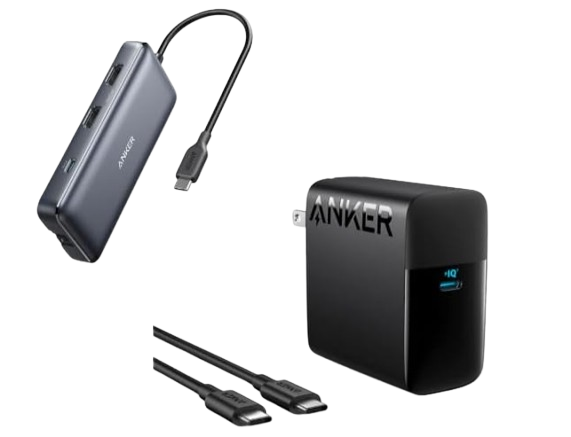
The Anker 553 is a powerful USB-C hub built for users who need many connection options. It includes one USB-C port, two USB-A data ports, two HDMI ports, an Ethernet port, and a microSD/SD card reader. All this connects through a single USB-C port, helping reduce cable clutter.
The hub supports dual HDMI display. You can stream or mirror content on one device at 4K at 60Hz, or connect two displays at 4K at 30Hz. It also supports Power Delivery, allowing pass-through charging up to 85W. This makes it useful for people who need both power and performance at the same time.
Features
-
One USB-C port for power and data
-
Two USB-A ports for data transfer
-
Two HDMI ports for 4K display support
-
Ethernet port for stable wired internet
-
MicroSD and SD card slots for quick file access
-
Power Delivery up to 85W for fast laptop charging
-
Supports 4K@60Hz single display or 4K@30Hz dual display
What Is the Good?
The Anker 553 handles multitasking easily. The dual HDMI ports make it ideal for users who prefer multiple screens. The 85W pass-through charging is fast enough to charge big devices like the MacBook Pro 16″ in around an hour and twenty minutes. The build feels solid, and Anker’s PowerIQ 3.0 ensures wide compatibility across devices.
This hub is perfect for people who edit videos, manage large files, or use multiple monitors. It keeps performance steady while transferring data or charging devices.
What Is the Bad?
It needs a 100W PD wall charger to achieve full charging speed. That charger is not included. Without the proper power source, performance can drop a little when several ports are active. The hub may also feel warm during long use.
Another small drawback is that it has no built-in cable, which makes it less compact for travel.
Overall Opinion
The Anker 553 gives strong value for its price. It delivers professional-level features like dual HDMI output, fast power delivery, and high-speed file transfer. It fits best in work setups that need multiple displays and quick power charging. For users who want a flexible hub for home or office, the 553 stands out as a powerful option.
Anker 555 USB-C Hub
Product Details
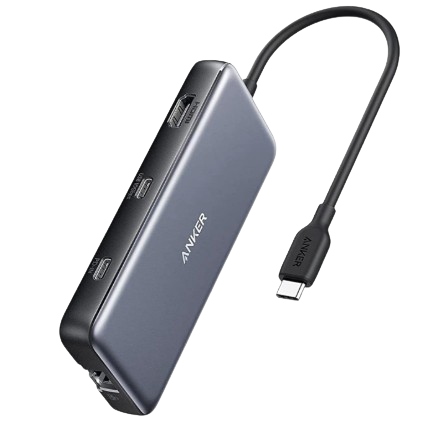
The Anker 555, also known as the PowerExpand 8-in-1 USB-C Hub, is designed with both flexibility and high performance in mind. It comes with a USB-C Power Delivery input port, a built-in 7.48-inch USB-C cable, a USB-C data port, two USB-A ports, an HDMI port, an Ethernet port, and a microSD/SD card reader.
It supports up to 4K at 60Hz video output for DP 1.4 laptops and 4K at 30Hz for DP 1.2 laptops. It also allows high-speed data transfer up to 10 Gbps on USB-C and USB-A ports. The hub supports up to 85W pass-through charging.
Features
-
One HDMI port for 4K video output
-
One USB-C Power Delivery input port
-
One USB-C data port
-
Two USB-A data ports
-
Ethernet port for wired network
-
SD and microSD card readers
-
Built-in USB-C cable for easy plug-and-play use
-
Data transfer speed up to 10 Gbps
-
Pass-through charging up to 85W
-
Supports DP 1.2 and DP 1.4 laptops
What Is the Good?
The Anker 555 offers fast transfer speeds and sharp video output. Its built-in cable adds convenience, removing the need for extra cables. The 4K@60Hz video support provides smooth visuals for work or entertainment.
The wide compatibility with MacBook, Windows, ChromeOS, and Thunderbolt systems makes it flexible. It also includes an 18-month warranty and friendly customer service.
The design is compact, making it easy to carry. It works well for students, professionals, and travelers who need a single hub for all tasks.
What Is the Bad?
The Anker 555 requires 15W of power to operate, so users need a 100W PD charger to ensure enough power for all devices. The HDMI port is the only one that supports video output. That limits display options compared to the 553.
It is also not compatible with Linux systems. Users with older laptops may need to check if their devices support DP Alt Mode before buying.
Overall Opinion
The Anker 555 gives great value in a smaller body. It supports faster data transfer than many hubs and delivers clean 4K video output. The built-in cable and wide compatibility make it practical. It is a smart choice for users who want reliable performance for daily work and travel without needing dual displays.
Detailed Comparison Anker 553 vs 555
Both Anker 553 and 555 offer high-quality build and great performance. The main difference lies in display and data transfer options. The Anker 553 supports dual HDMI ports, letting users connect two monitors. This is helpful for designers, coders, or office users who multitask. The Anker 555, in contrast, has only one HDMI port, but it supports higher data transfer speeds up to 10 Gbps.
In charging, both deliver up to 85W Power Delivery but need a 100W charger for best results. The Anker 553 uses a detachable cable, while the 555 has a built-in 7.48-inch cable that feels more convenient for travel.
For video performance, both support 4K output, but the 555’s 4K@60Hz feature works only on DP 1.4 laptops. The 553 offers 4K@60Hz on a single display and 4K@30Hz on dual displays, which gives more flexibility.
Both have SD and microSD card slots, Ethernet ports, and USB-A connections. Yet the Anker 555 stands out with faster data transfer and modern compatibility with USB4 and Thunderbolt.
If you need two monitors and strong workstation setup, the Anker 553 is better. For fast data transfer and portable design, the Anker 555 is ideal.
FAQs
Which model supports dual monitors?
The Anker 553 supports two HDMI displays at 4K@30Hz. The Anker 555 supports only one HDMI display.
Can both charge a laptop while in use?
Yes, both support Power Delivery pass-through charging up to 85W. A 100W PD charger is needed for full performance.
Which is faster for file transfers?
The Anker 555 supports data speeds up to 10 Gbps, which is faster than the Anker 553.
Do these hubs work with MacBook and Windows laptops?
Yes, both are compatible with macOS, Windows, and ChromeOS systems that support DP Alt Mode and Power Delivery.
Can I use them with my phone or tablet?
Yes, both support PowerIQ 3.0 technology for phones and tablets with USB-C ports.
Which is more travel-friendly?
The Anker 555 is more compact and has a built-in cable, making it easier to carry.
Conclusion
Both the Anker 553 and 555 hubs serve different user needs. The 553 is great for people who use multiple screens and need strong power delivery. The 555 suits those who want high-speed file transfer, light weight, and easy portability.
Each model delivers stable performance and dependable build quality. Choosing between them depends on what matters most — more screens or faster data transfer.